
 LinkedIn.
 Like.
Like.
 Tweet.
 Gab.
Gab.
 Gettr.
 YouTube.
 Rumble.
 Email friends.
 Email ILANA
 print
print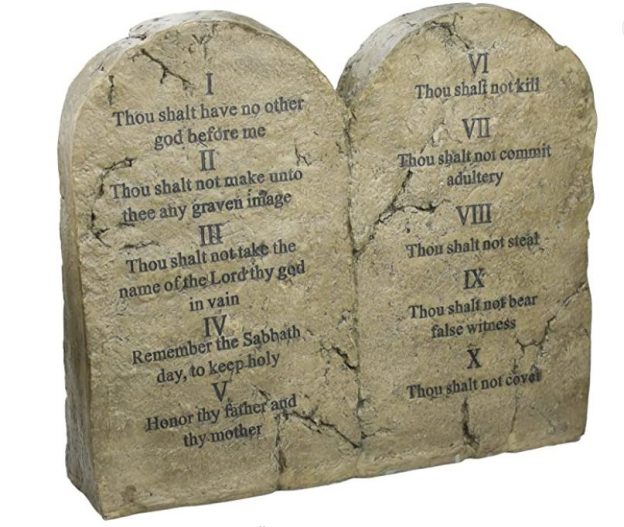
Alabama Supreme Court Chief Justice Roy Moore paid for and placed a granite monument inscribed with the Ten Commandments in the Alabama judicial building, where he presides. This was two years ago. Predictably, the American Civil Liberties Union (ACLU) could not tolerate the sight of a moral code displayed on taxpayer-funded property. Together with Americans United for Separation of Church and State, the ACLU alleged the justice had violated the Establishment Clause of the First Amendment.
A district judge by the name of Myron Thompson then ordered the removal of the Decalogue. Moore appealed to the U.S. Supreme Court for an emergency stay. When this was denied, a nine-member state tribunal suspended him with pay. If the monument is not removed, the plaintiffs want Moore held in contempt and fines levied against the state.
First Amendment jurisprudence has tended to see the injunction against the establishment of a state religion as an injunction against the expression of faith—especially discriminating against the founding Judeo-Christian faith—in taxpayer-supported spheres. The end result has been the expulsion of religion from the public square and the suppression therein of freedom of religion.
Thomas Jefferson was prolific on the topic of religious freedom—the Virginia Statute for Religious Freedom was a crowning achievement for which he wished to be remembered, along with the Declaration of Independence and the founding of the University of Virginia.
With “Congress shall make no law respecting the establishment of religion, or prohibiting the exercise thereof,” Jefferson intended, according to David N. Meyer, author of Jefferson’s Constitutional Thought, to guarantee both “an absolute free exercise of religion and an absolute prohibition of an establishment of religion.”
It’s difficult to see how the display of the Decalogue constitutes an establishment of a state religion or why Moore should be forbidden to so express his faith. The Ten Commandments are a civilizing moral code. Fine, the first few Commandments, among which are Commandments that exhort against idolatry and pantheism, do pertain to ethical monotheism. But other than those, why would anyone (bar the ACLU) object to “thou shall not kill,” or to “thou shall not commit adultery, steal, or covet?” The Ten Commandments can hardly be perceived as an instrument for state proselytization.
However obvious, this is not the soul of the subject in the case of Justice Moore.
Back to Jefferson: “I consider the government of the U.S. as interdicted by the Constitution from intermeddling with religious institutions, their doctrines, discipline, or exercise,” Jefferson expatiated. He then gets to the essence of the issue: “This results not only from the provision that no law shall be made respecting the establishment, or free exercise of religion but also from the Tenth Amendment, which reserves to the states [or to the people] the powers not delegated to the U.S.”
That was true until the ratification of the 14th Amendment!
Prior to that, the federal government had no authority to enforce the Bill of Rights in the states, religious freedoms included. The Bill of Rights, very plainly, did not grant the federal government any powers, but was intended to place limits on the federal government’s actions. Ratified illegally after the War Between the States, the 14th Amendment overrode, to all intents and purposes, the doctrine of states’ rights, to which Jefferson looked for the preservation of freedoms.
The particular portion of the miscellany that is the 14th states: “No State shall make or enforce any law which shall abridge the privileges and immunities of citizens of the United States; nor shall any state deprive any person of life, liberty, or property without due process of law; nor deny to any person within its jurisdiction the equal protection of the laws.” The gargantuan grant of power to the federal government is thus sealed: “The Congress shall have power to enforce, by appropriate legislation, the provisions of this article.”
In American federalism, the rights of the individual are secured through the strict limits imposed on the power of the central government by a Bill of Rights and the division of authority between autonomous states and a federal government. As Frank Chodorov wrote, states’ rights are “an essential Americanism. The Founding Fathers and the opponents of the Constitution agreed on the principle of divided authority as a safeguard to the rights of the individual.”
If the Bill of Rights was intended to place strict limits on federal power and protect the individual from government, the 14th, in effect, defeated that purpose. What it did was to put the power to enforce the Bill of Rights in federal hands, where it was never intended to be.
Naturally, states can just as well violate individual rights. But, as Chodorov highlighted, there is no monopoly power behind a state’s action. If a state wants to outlaw alcohol, then one can move to a state that doesn’t. (That’s one way for state legislators to ensure that their states will be as densely populated as the moon.) If a state wants to establish a religion, and its own constitution doesn’t prohibit this, one can move to a state with a different constitution. Competition in government puts the brakes on folly and abuse and preserves freedom.
The 14th Amendment violated this balance, or as Felix Morley observed in Freedom and Federalism, it nullified “the original purpose of the Bill of Rights, by vesting its enforcement in the national rather than in the state governments.” This just about renders asunder the Ninth and 10th amendments—what powers do the states retain if the federal government has gobbled them all up?
When the federal government became the arbiter of individual rights—freedom of religion included—the doctrine of limitation of powers was badly damaged, if not destroyed. In the real world, as opposed to the wasteland of pure theory, government—especially centralized government—is the natural enemy of natural rights. Putting the central government in exclusive charge of protecting natural rights is the height of folly.
Judge Moore rightly proclaimed his innocence in the Wall Street Journal. “The First Amendment says that ‘Congress shall make no law respecting the establishment of religion, or prohibiting the free exercise thereof.’ It does not take a constitutional scholar to recognize that I am not Congress, and no law has been passed,” he protests.
However, when the Justice proclaims, “The Ninth Amendment secured our right as a people. The 10th guaranteed our right as a sovereign state,” he is neglecting that along came the 14th and did away with all that.
Justice Roy Moore has more on his hands than he bargained for, although his passions are well suited to begin the necessary groundswell that’ll see the repeal of the 14th Amendment.
©By ILANA MERCER
WorldNetDaily.com
August 27, 2003
CATEGORIES: Constitution, Federalism, Founding Fathers, Individual rights, Private Property Rights, Religion & Faith, States' Rights